


Exploding Hydrogen Balloon
Author: Sangyoon Lee
Introduction
Hydrogen (H₂) is the lightest and simplest chemical element; it is colorless, odorless, and highly flammable. It also makes up roughly 75% of all elemental matter in the universe, which is why hydrogen is widely used in energy science and industry. Beyond its abundance, hydrogen has another key characteristic: high energy content. Hydrogen has the highest energy content per unit weight of any common fuel.
To test whether hydrogen truly has high energy content, we conducted an experiment in which we built a system to produce pure hydrogen gas using acid and aluminum foil.
Hypothesis
Hydrogen is both flammable and energy-dense. Therefore, if we ignite a balloon filled with pure hydrogen gas, the hydrogen will react with oxygen in the air to form water vapor, releasing a massive amount of energy that instantly heats and expands the surrounding air, producing an explosion.
Materials
-
1 Erlenmeyer flask
-
2 hoses of different widths
-
Balloons (quantity depending on number of trials)
-
1 two-liter plastic bottleWater (approximately 2 L)
-
300 mL acid
-
1 rubber bottle cork
-
2 long, inflammable sticks
Building the Hydrogen Gas Production System
-
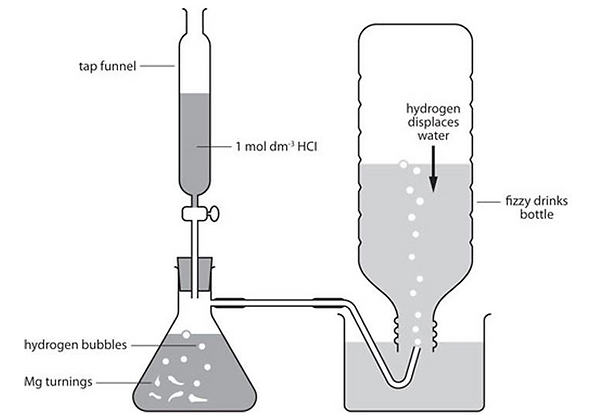
Cut a hole in the rubber cork matching the width of the hose.
-
Thread one hose through the cork, leaving 2–3 cm protruding from the end that will not touch the acid.
-
Seal the hose to the cork with a glue gun.
-
Cut a hole in the lower side of the plastic bottle matching the width of the hose.
-
Thread the other end of the hose through this hole so that 2–3 cm extends into the bottle (submerged in water).
-
Seal the hose to the bottle with a glue gun.
-
Cut a hole matching the hose's width in the plastic bottle's lid.
-
Thread the second hose through the lid by 2–3 cm.
-
Seal the hose to the lid with a glue gun.
-
Secure the cork and lid onto their respective bottles.
Procedure
-
Pour 300 mL of water and 300 mL of acid into the flask.
-
Fill the plastic bottle with water until it is roughly ¾ full (about 1.5 L).
-
Secure the lid, attach a balloon to the hose, and hold them together tightly to prevent hydrogen gas from leaking.
-
Tear the aluminum foil into pieces and drop them into the flask, then quickly secure the cork to seal in the hydrogen gas produced by the reaction.
-
Once the reaction stops, carefully disconnect the hose from the balloon and tie off the balloon.
-
Tape or attach the balloon to the end of one long stick. Light a match and attach it to the end of the second stick.
-
Standing as far away as possible, use the lit match to ignite the balloon.
Safety Precautions
-
Do not inhale any hydrogen gas.
-
Wear safety gear (goggles, gloves) throughout the entire experiment.
-
Perform this experiment outdoors only.
-
Do not release the balloon once it is filled with hydrogen — it will float away, since hydrogen is lighter than air.
Results
As predicted in the hypothesis, igniting the balloon produced an explosion, accompanied by a dramatic yellow fireball.
Explanation of Results
As discussed in the introduction, hydrogen reacts with oxygen to form water vapor and flame. The heat from this initial reaction provides the energy needed to break hydrogen's molecular bonds, releasing a large amount of stored energy in the form of an explosion.
Conclusion
The experiment supports the hypothesis that hydrogen has a high energy content: the explosion released a substantial amount of energy, consistent with hydrogen's known potential energy density. Future experiments could investigate whether there is a measurable difference in energy output between pure hydrogen and hydrogen mixed with other elements, such as in a stoichiometric mixture.
References
-
U.S. Department of Energy. "Hydrogen Fuel Basics." energy.gov
-
MangoSTEM. "Summer 2022." mangostem.org
-
UC Davis ChemWiki. "Exploding Balloons." chem.libretexts.org
-
https://www.energy.gov/cmei/fuels/hydrogen-fuel-basicshttps://www.mangostem.org/summer-2022
-
https://chem.libretexts.org/Courses/University_of_California_Davis/UCDemos/Exploding_Balloons
Images


.jpeg)
.jpg)

Is Ai Generated Code Better Than Hand-written Code?
Author: Sangyoon Lee
Introduction
Artificial Intelligence (AI) is already widely used in today’s businesses, especially, the software business is undergoing a huge transformation. According to a Github survey from 500 different U.S-based software engineers, 92% of them are using AI coding tools in and outside of their work. However, as every new tool is invented, they have to go through careful examination whether it will be helpful or not. So, this paper will analyze pros and cons of AI generated code and discuss whether it’s helpful to the industry.
Before we talk about pros and cons of AI generated code, it’s important to know what AI generated code is and how it is generated. AI generated code is code generated by AI code generator, which is a combination of Machine Learning (ML) and AI to help developers to analyze and improve their code faster while maintaining high quality. In AI coding generators, ML has a crucial function in understanding and processing code that the developer intended.
Benefits of AI generated code
First, using AI generated code is more efficient than hand written code. AI code generators can write repetitive code really fast, so developers can focus on more complex and crucial parts of the code. Also, it gives developers a commonly used template or format of the code, which saves a lot of time for developers because they don't have to write their code from scratch.
Second, AI generators allow faster and flexible debugging. Most AI coding tools have features that notice developers if they have an error while writing their code. This significantly reduces the number of errors and mistakes that are crucial in code writing. Additionally, these generated codes have a certain style or format and often come with detailed comments, which helps developers to understand the logic and structure of the code better and fix errors of the code faster.
Cons of using AI generated code
Although the benefits listed above look really good and tempting, there are some potential risks that have to be discussed before we utilize AI generators. First, there are some concerns about uncertainty in how these tools are considering regulatory, privacy, and security standards for generated code and user data. For example, AI can use open-source codes that are licensed and under strict terms, which can possibly be illegal. Also, most AI code generators do not offer legal support in case of dispute, which means incautious use of AI code generators can result in significant legal and reputational cost that can outweigh all the benefits listed before.
Second, during the training section of AI, where it gathers vast amounts of information to improve their quality of work, they might get infected by cybercriminals and get wrong information from them. It can result in generators writing malicious code for developers, which possibly can expose organizations to a range of really serious consequences, such as data theft or malware propagation across networks and devices.
Lastly, overreliance on AI code generators can cause erosion of essential coding skills of developers, especially inexperienced developers, such as critical thinking and problem-solving skills. AI code generators are very effective at doing repetitive jobs, but they are not suitable for jobs that require high-level creativity. Also, since AI can have errors, bugs, or inefficiency in their code, keeping up with latest coding standards and practices is crucial for developers, so they can validate AI generated code.
Conclusion
In conclusion, the key is to find the middle ground in usage of AI. Integrating AI tools into an organization's infrastructure in a way that can highlight its benefits and reduce the risk of it. Therefore, to effectively evaluate an AI code generator’s security and compliance level, code generation and its review capabilities, and model transparency requires detailed analysis by technology experts, such as developers and data and AI experts.
References
https://htec.com/insights/blogs/dual-edge-ai-coding-pros-cons-using-ai-code-generators/
https://github.blog/news-insights/research/survey-reveals-ais-impact-on-the-developer-experience/
Images
https://datasciencedojo.com/blog/ai-code-generator/
https://epigra.com/en/blog/top-10-code-generators-ai-and-editors


